Indoor Air Quality in Midwest City, OK | Free Estimates · Licensed Since 2009
Whole-home air quality systems — media filtration, UV purification, humidifiers, dehumidifiers, fresh-air ventilation. Serving Midwest City and the OKC metro since 2009. OK CIB #00125054. A+ BBB. 5.0★ from 111 5-star Google reviews.
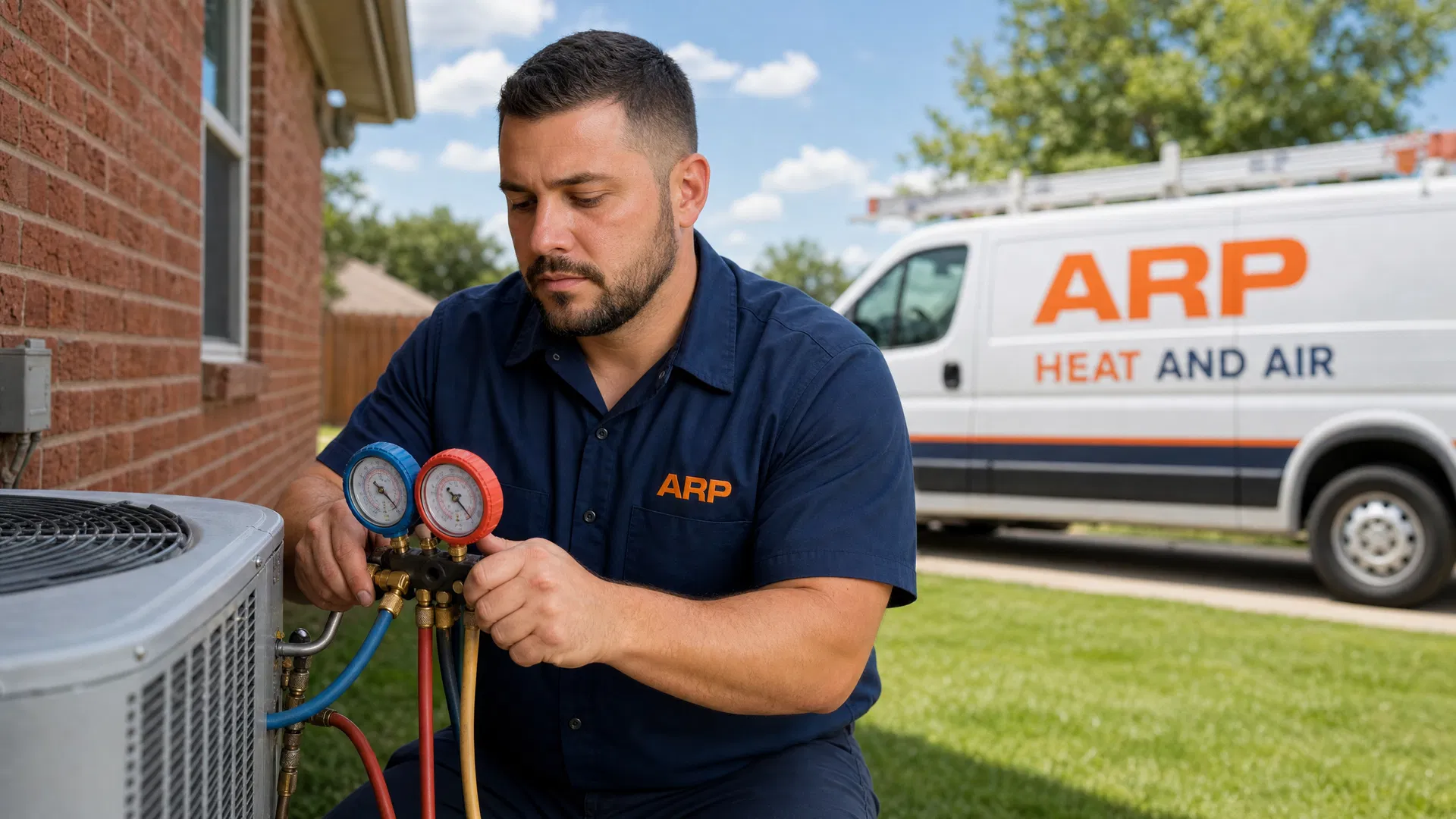
What to Expect: Indoor Air Quality in Midwest City
Midwest City Indoor Air Quality calls keep us busy from year-round — and we've built our schedule around being available when Midwest City homeowners actually need us. From our Edmond shop, we reach Midwest City in 30–45 minutes. We cover all of Midwest City including Oklahoma County ZIPs 73110, 73130, 73140.
Midwest City is built around Tinker Air Force Base, which is the largest employer in Oklahoma and shapes a lot of the housing market. We see a high proportion of military-family rental homes (frequent turnover, deferred maintenance), base housing-adjacent neighborhoods (Sooner Rose, Heritage Park), and longtime Tinker-employee owned homes in Country Estates and Soldier Creek areas. The housing stock leans heavily 1950s-1970s — Midwest City grew up with Tinker after WWII.
Soldier Creek and the area along SE 15th and SE 29th have a lot of 1950s-1960s slab ranches with original gas furnaces in interior closets and ductwork in the attic. Many of these homes have asbestos duct insulation that requires careful handling on duct replacement or repair — we test before disturbing any old duct wrap and follow EPA protocols for abatement when needed. Older Midwest City homes also commonly have 1.5-2 ton AC sized for 1,200-1,400 sq ft, which is generally appropriate but means the equipment runs hard during peak summer.
Midwest City was built primarily in the 1940s-1950s to support Tinker Air Force Base personnel and shares OKC's tornado-belt weather patterns. Tinker AFB military housing has its own maintenance contracts, but civilian Midwest City homes adjacent to the base often house military families with shorter residence durations — meaning deferred HVAC maintenance is common as homes turn over every 2-4 years.
Midwest City is one of the metro's oldest planned suburbs — most original housing is 1940s-1960s small ranch homes with original gravity-converted ductwork and undersized return-air systems. Heritage Park and Soldier Creek areas have aging electric-furnace systems from the all-electric utility push of the 1970s. Newer construction is concentrated near SE 29th and around Town Center, with much smaller infill numbers than the surrounding metro.
Midwest City has a lot of military families rotating through — we treat every customer like they're staying permanently, because the house is staying even if the family moves. Honest work, fair pricing, no shortcuts.
Frequent Indoor Air Quality Issues in Midwest City
Across our service area, certain indoor air quality situations come up over and over. Here are the ones we see most often in Midwest City and how we approach them:
Dust accumulating fast after cleaning
A failing capacitor puts enormous strain on the compressor — the most expensive component in the system ($1,200–$2,000 to replace). Replacing a weak capacitor when it first shows signs of failure is one of the most cost-effective preventive steps in HVAC maintenance. We stock capacitors for every major brand on the truck.
Allergies worse indoors than out
A refrigerant leak that's been going for a season will eventually drop the charge enough that the system runs but can't maintain temperature. We measure superheat and subcooling to determine exact charge — not just 'add some refrigerant and see if it helps.'
Dry air in winter — static, cracked skin, scratchy throats
An oversized breaker is a common mistake from previous HVAC work in Midwest City — if someone installed a 40A breaker on a circuit that should be 30A, the breaker won't trip when it should, masking a real fault. We check breaker sizing against equipment specs on every electrical diagnostic.
Muggy indoor air in summer despite running AC
Ice on the outdoor unit in summer in Midwest City means the refrigerant pressure is too low — the evaporator is running colder than it should. Turn the system off, let it thaw (2–4 hours), then call us. Running a frozen system can damage the compressor.
Musty smell from registers
Loud noises from HVAC equipment in Midwest City are almost always a mechanical problem that gets worse if ignored. Screeching is usually a bearing — blower motor or inducer motor. Grinding is metal-on-metal contact. Banging is a loose or broken component. We identify the source before it causes secondary damage.
Visible mold around vents
Zoning system failures in Midwest City homes can cause short-cycling — if a zone damper is stuck closed, the system has nowhere to push air and shuts down on high pressure. We test zone damper operation and bypass damper function as part of every short-cycling diagnostic.
How We Handle Indoor Air Quality Service Calls in Midwest City
- Same-day schedulingWe discuss your specific concerns (allergies, dust, dryness, smells), check filter condition, measure indoor humidity, and inspect the air handler and ductwork.
- Thorough diagnosticDifferent problems need different solutions. We do not push the same UV light on everyone.
- Written quote before workItemized parts and labor. Often a phased approach (start with media filtration, add UV-C and humidifier next season) is more practical than everything at once.
- Efficient repairMost IAQ installs: 2-4 hours. Some (whole-home dehumidifier, HEPA bypass, ERV/HRV) take a full day with ductwork modifications.
- Commissioning and walkthroughFilter replacement schedule, humidifier water connection check, UV bulb replacement schedule (12-24 months typical).
Typical Indoor Air Quality Pricing in Midwest City, Oklahoma
- 5-inch media filter cabinet (Aprilaire 1210 or similar): $450-$750
- UV-C germicidal light (coil sterilization): $350-$550
- Whole-home humidifier (Aprilaire 600/700): $450-$750
- Whole-home dehumidifier (Aprilaire 1830 or similar): $1,800-$2,800
- HEPA bypass filter system: $1,200-$2,200
- Fresh-air ventilator (ERV/HRV): $1,800-$3,500
- Duct sealing (mastic and aeroseal): $600-$1,800
Financing from $79/month
Qualified buyers can finance at 0% APR. Standard fixed-rate financing is available for 640+ credit, and secondary options go down to 580. Because approval is a same-day soft pull, there is no impact to your credit score until you accept, and no tier carries a prepayment penalty.
See Financing DetailsWhat We See in Midwest City — Indoor Air Quality Service Patterns
Indoor air quality issues in Midwest City most commonly involve: high humidity from local environmental conditions, duct contamination in older housing stock, and inadequate filtration in systems that were designed before modern IAQ standards. Midwest City's 1940s–1980s housing stock has a mix of tight modern construction and older homes with significant air infiltration.
Serving Midwest City Neighborhoods
Midwest City's neighborhoods reflect the community's history as a planned city adjacent to Tinker AFB. The neighborhoods closest to the base — Midwest Acres, Del Crest, and the streets along SE 59th — are primarily 1950s to 1970s construction. The mid-city neighborhoods are 1970s to 1990s construction. The newer Midwest City developments in the east and south are 1990s to 2010s construction. The proximity to Tinker AFB means some Midwest City neighborhoods have higher particulate levels than typical residential areas. We are familiar with the equipment that dominates each Midwest City neighborhood.
Common Indoor Air Quality Issues in Midwest City
Indoor air quality service in Midwest City covers assessment, filtration, humidity control, and duct cleaning. Common IAQ issues:
- High humidity from Midwest City's local environmental conditions — promotes mold and dust mite growth
- Duct contamination in older housing stock — accumulated dust, debris, and biological growth
- Inadequate filtration — standard 1-inch filters don't capture fine particles
- Air infiltration in older homes — outdoor pollutants entering through gaps in the building envelope
Midwest City Homeowners Ask About Indoor Air Quality
Family-Owned vs. Franchise: Why It Matters for Midwest City Residents
When a franchise HVAC company services your home in Midwest City, the technician is often a recent hire working toward a sales quota. When ARP handles your indoor air quality, you're dealing with a company where the owner's name is on every invoice and his personal reputation is tied to every job. our team has been doing HVAC in the OKC metro since 2009 — long enough that he now services systems he originally installed. That continuity means he knows the common failure patterns in Midwest City's housing stock, carries the right parts, and gives you an honest assessment of whether repair or replacement makes more financial sense for your specific situation.
Do you serve Midwest City for indoor air quality?
Yes — Midwest City is in our regular service area. From our Edmond shop, we reach Midwest City in 30–45 minutes via I-40. Same-day service is available for most Midwest City calls. We cover all Oklahoma County ZIPs in Midwest City: 73110, 73130, 73140.
Does ARP serve the area near Tinker Air Force Base?
Yes — we serve the entire Midwest City area including neighborhoods near Tinker Air Force Base. If you're in Midwest City, you're in our service area. Call (405) 413-0583 for same-day availability.
What is the most important indoor air quality upgrade for Oklahoma?
For most homes, a 5-inch media filter cabinet is the highest-impact upgrade. It traps 6× more particulate than a standard 1-inch filter, lasts 6-12 months instead of monthly, and reduces airflow restriction (improving system efficiency). Cost: $450-$750 installed. Pays for itself in filter savings within 2 years.
Do UV lights actually work?
For specific purposes, yes. UV-C lights aimed at the indoor evaporator coil prevent biofilm growth (which is real and impacts efficiency). UV-C in the air stream is less effective because contact time is too short. Marketing claims about killing viruses in passing air are mostly oversold. We install coil-treatment UV-C, not air-stream UV-C.
Why is my house so dry in winter?
Furnace heat dries indoor air — every BTU of heat reduces relative humidity. Oklahoma winter indoor humidity typically drops to 15-25%. Healthy range is 30-45%. A whole-home bypass humidifier ($450-$750 installed) connects to the furnace and humidifies the air leaving the system.
Do I need a dehumidifier with my AC?
Most properly-sized AC systems dehumidify adequately during summer cooling. If your AC is oversized (which is extremely common), it short-cycles and never gets to dehumidification — you feel cold and clammy. A whole-home dehumidifier ($1,800-$2,800) is the right fix when AC sizing cannot be changed.
Will an air purifier help with my allergies?
Yes, meaningfully. Oklahoma's pollen counts are among the highest in the country. A 5-inch media filter rated MERV 13 or higher captures most pollen, dust mite debris, and pet dander. HEPA bypass systems capture even more (down to 0.3 microns), but are 3-4× the cost.
How often should I change my filter?
Standard 1-inch filter: every 1-3 months depending on shedding pets, dust, and runtime. 5-inch media filter: every 6-12 months. HEPA bypass: every 12 months typically. Set a calendar reminder — most "AC problems" we get called for trace back to a clogged filter someone forgot about.
What is an ERV or HRV?
Energy Recovery Ventilator (ERV) and Heat Recovery Ventilator (HRV) provide fresh outdoor air to your home while recovering heat and (for ERV) humidity from the outgoing stale air. Useful for tight modern homes that have minimal natural air leakage. Cost: $1,800-$3,500 installed.
Can you test my indoor air quality?
We can do basic measurements (humidity, particulate from a clean filter sample, visual mold inspection). For specific contaminants (VOCs, formaldehyde, mold spore counts, radon), we refer to certified indoor air quality testing services.
Local context for indoor air quality work in Midwest City
Typical Midwest City housing stock
Midwest City was built up around Tinker Air Force Base after WWII, so a remarkable portion of the housing stock is the same era — 1950s–1960s ranch homes with original ductwork. Many of these houses are now on their second or third HVAC system but still on the original duct runs.
What we typically see in Midwest City
The single most common Midwest City service pattern: replacement system installed correctly, but the existing ductwork is undersized for it, so the new system short-cycles or struggles to dehumidify in summer. We measure static pressure on every replacement quote here for exactly this reason.
From our team
Typical response is 30–45 minutes from our Edmond shop. If you're in an original-era Midwest City home, we'll check the duct sizing before we quote you a system — putting a 4-ton AC on 2.5-ton ductwork is a setup for a callback, not a fix.
All HVAC Services in Midwest City, OK
AC Repair
$185-$650 typical
AC Installation
$4,000-$10,500 installed
AC Maintenance
$129 single visit · $189/year membership
Furnace Repair
$150-$800 typical
Furnace Installation
$3,500-$7,500 installed
Heat Pump Services
$5,500-$12,500 installed; repair varies
Emergency HVAC
$89 diagnostic, no overtime — same as business hours
Ductless Mini-Splits
$3,500-$5,500 single-zone; $7,500-$14,000 multi-zone
Thermostat Services
$195-$450 installed
Commercial HVAC
Quote by project
Ventilation Services
Quote by project; basic seal $600-$1,200