Indoor Air Quality in Oklahoma City, OK | Free Estimates · Licensed Since 2009
Whole-home air quality systems — media filtration, UV purification, humidifiers, dehumidifiers, fresh-air ventilation. Serving Oklahoma City and the OKC metro since 2009. OK CIB #00125054. A+ BBB. 5.0★ from 111 5-star Google reviews.
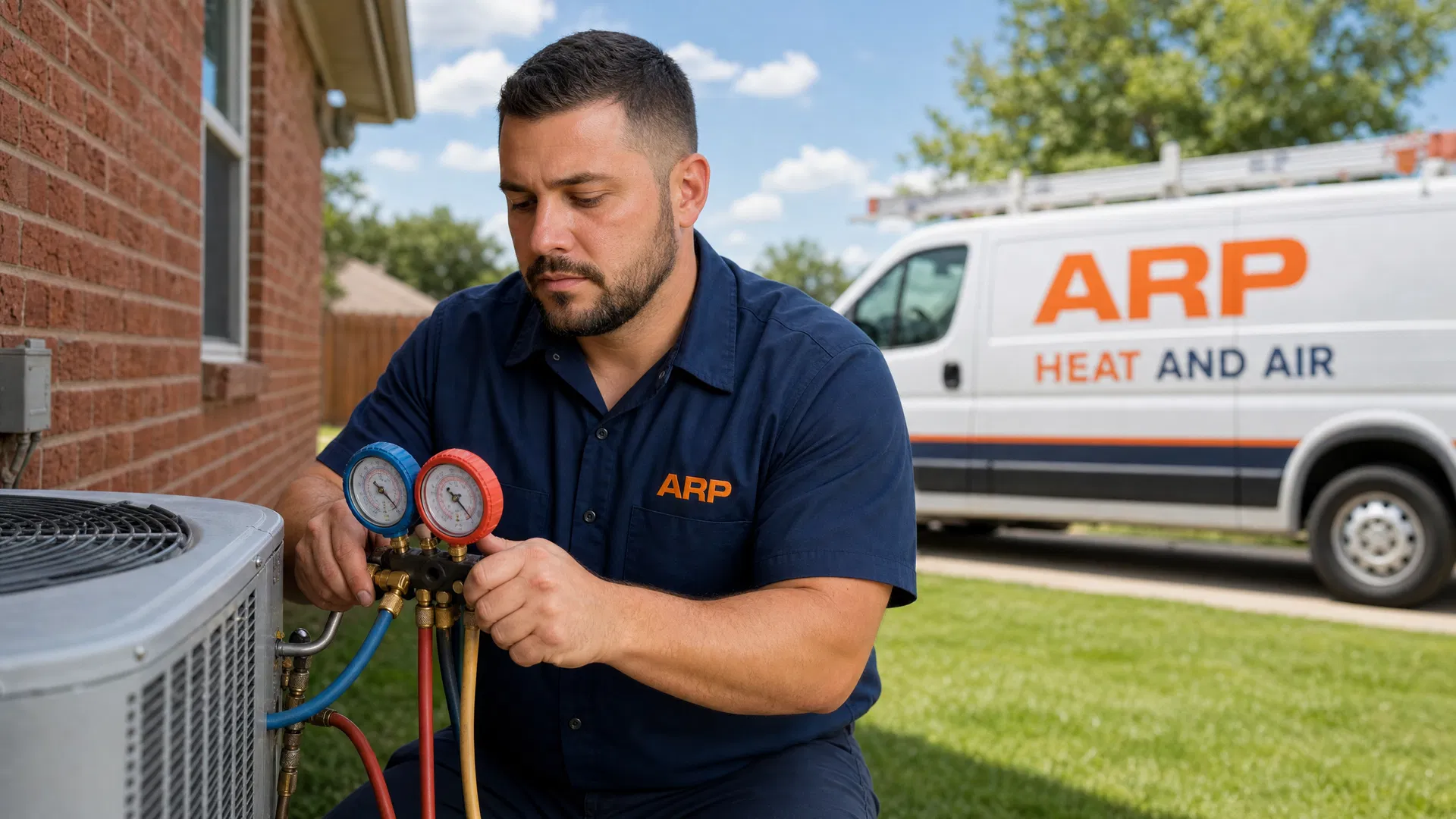
Indoor Air Quality Service for Oklahoma City Homeowners
Indoor air quality in Oklahoma City is shaped by the local environment — 1940s–2010s from pre-war bungalows in historic districts to newer builds in northwest OKC housing stock, elevated humidity levels, and Oklahoma City's specific outdoor air quality conditions. We assess IAQ issues with actual measurements before recommending solutions.
Oklahoma City's housing stock includes many older homes with original ductwork that accumulates dust, debris, and biological growth over decades. Duct cleaning and sealing often has a bigger impact on indoor air quality than standalone air purifiers.
Indoor Air Quality Problems in Oklahoma City — What Comes Up Most
Across our service area, certain indoor air quality situations come up over and over. Here are the ones we see most often in Oklahoma City and how we approach them:
Dust accumulating fast after cleaning
A failing capacitor puts enormous strain on the compressor — the most expensive component in the system ($1,200–$2,000 to replace). Replacing a weak capacitor when it first shows signs of failure is one of the most cost-effective preventive steps in HVAC maintenance. We stock capacitors for every major brand on the truck.
Allergies worse indoors than out
A refrigerant leak that's been going for a season will eventually drop the charge enough that the system runs but can't maintain temperature. We measure superheat and subcooling to determine exact charge — not just 'add some refrigerant and see if it helps.'
Dry air in winter — static, cracked skin, scratchy throats
An oversized breaker is a common mistake from previous HVAC work in Oklahoma City — if someone installed a 40A breaker on a circuit that should be 30A, the breaker won't trip when it should, masking a real fault. We check breaker sizing against equipment specs on every electrical diagnostic.
Muggy indoor air in summer despite running AC
Ice on the outdoor unit in summer in Oklahoma City means the refrigerant pressure is too low — the evaporator is running colder than it should. Turn the system off, let it thaw (2–4 hours), then call us. Running a frozen system can damage the compressor.
Musty smell from registers
Loud noises from HVAC equipment in Oklahoma City are almost always a mechanical problem that gets worse if ignored. Screeching is usually a bearing — blower motor or inducer motor. Grinding is metal-on-metal contact. Banging is a loose or broken component. We identify the source before it causes secondary damage.
Visible mold around vents
Zoning system failures in Oklahoma City homes can cause short-cycling — if a zone damper is stuck closed, the system has nowhere to push air and shuts down on high pressure. We test zone damper operation and bypass damper function as part of every short-cycling diagnostic.
Our Indoor Air Quality Service Process for Oklahoma City Homeowners
- You call or textWe discuss your specific concerns (allergies, dust, dryness, smells), check filter condition, measure indoor humidity, and inspect the air handler and ductwork.
- I come to youDifferent problems need different solutions. We do not push the same UV light on everyone.
- Diagnosis first, quote secondItemized parts and labor. Often a phased approach (start with media filtration, add UV-C and humidifier next season) is more practical than everything at once.
- Same-day repair when possibleMost IAQ installs: 2-4 hours. Some (whole-home dehumidifier, HEPA bypass, ERV/HRV) take a full day with ductwork modifications.
- Commissioning and walkthroughFilter replacement schedule, humidifier water connection check, UV bulb replacement schedule (12-24 months typical).
Typical Indoor Air Quality Pricing in Oklahoma City, Oklahoma
- 5-inch media filter cabinet (Aprilaire 1210 or similar): $450-$750
- UV-C germicidal light (coil sterilization): $350-$550
- Whole-home humidifier (Aprilaire 600/700): $450-$750
- Whole-home dehumidifier (Aprilaire 1830 or similar): $1,800-$2,800
- HEPA bypass filter system: $1,200-$2,200
- Fresh-air ventilator (ERV/HRV): $1,800-$3,500
- Duct sealing (mastic and aeroseal): $600-$1,800
Financing from $79/month
We keep financing simple: 0% APR for those who qualify, fixed-rate options for 640+ credit, and secondary lenders for scores as low as 580. The soft-credit approval is same-day and leaves your score untouched until you accept terms — and you can pay off any tier early with no penalty.
See Financing DetailsWhat We See in Oklahoma City — Indoor Air Quality Service Patterns
Indoor air quality issues in Oklahoma City most commonly involve: high humidity from local environmental conditions, duct contamination in older housing stock, and inadequate filtration in systems that were designed before modern IAQ standards. Oklahoma City's 1940s–2010s housing stock has a mix of tight modern construction and older homes with significant air infiltration.
Serving Oklahoma City Neighborhoods
Oklahoma City's neighborhoods span a wide range of construction eras and housing types. The historic neighborhoods (Mesta Park, Heritage Hills, Crown Heights) are primarily 1910s to 1940s construction with aging HVAC equipment. The mid-century neighborhoods (Nichols Hills adjacent, Edgemere Park, Shepherd) are 1950s to 1970s construction. The suburban OKC neighborhoods (Quail Creek, Gaillardia area, Deer Creek area) are 1970s to 2000s construction. The newer OKC developments are 2000s to 2020s construction. We are familiar with the equipment that dominates each OKC neighborhood.
Common Indoor Air Quality Issues in Oklahoma City
Indoor air quality service in Oklahoma City covers assessment, filtration, humidity control, and duct cleaning. Common IAQ issues:
- High humidity from Oklahoma City's local environmental conditions — promotes mold and dust mite growth
- Duct contamination in older housing stock — accumulated dust, debris, and biological growth
- Inadequate filtration — standard 1-inch filters don't capture fine particles
- Air infiltration in older homes — outdoor pollutants entering through gaps in the building envelope
Indoor Air Quality FAQs from Oklahoma City Homeowners
No Overtime Fees. No Dispatch Fees. No Membership Required.
The three things Oklahoma City homeowners tell us they hate most about big HVAC companies: the $75–$150 dispatch fee just to show up, the overtime surcharge when the AC breaks on a Saturday in July, and the pressure to sign a monthly maintenance contract to get a reasonable price. ARP charges none of those. The $89 diagnostic applies to your repair. Weekend and evening calls are the same rate as weekday calls. And every indoor air quality quote in Oklahoma City is a flat price — no hidden fees discovered after the work is done. That's been the policy since 2009 and it's not changing.
Do you serve Oklahoma City for indoor air quality?
Yes — Oklahoma City is in our regular service area. From our Edmond shop, we reach Oklahoma City in 25–50 minutes depending on area. Same-day service is available for most Oklahoma City calls. We cover all Oklahoma County ZIPs in Oklahoma City: 73101, 73102, 73103.
Does ARP serve the area near Bricktown?
Yes — we serve the entire Oklahoma City area including neighborhoods near Bricktown. If you're in Oklahoma City, you're in our service area. Call (405) 413-0583 for same-day availability.
What is the most important indoor air quality upgrade for Oklahoma?
For most homes, a 5-inch media filter cabinet is the highest-impact upgrade. It traps 6× more particulate than a standard 1-inch filter, lasts 6-12 months instead of monthly, and reduces airflow restriction (improving system efficiency). Cost: $450-$750 installed. Pays for itself in filter savings within 2 years.
Do UV lights actually work?
For specific purposes, yes. UV-C lights aimed at the indoor evaporator coil prevent biofilm growth (which is real and impacts efficiency). UV-C in the air stream is less effective because contact time is too short. Marketing claims about killing viruses in passing air are mostly oversold. We install coil-treatment UV-C, not air-stream UV-C.
Why is my house so dry in winter?
Furnace heat dries indoor air — every BTU of heat reduces relative humidity. Oklahoma winter indoor humidity typically drops to 15-25%. Healthy range is 30-45%. A whole-home bypass humidifier ($450-$750 installed) connects to the furnace and humidifies the air leaving the system.
Do I need a dehumidifier with my AC?
Most properly-sized AC systems dehumidify adequately during summer cooling. If your AC is oversized (which is extremely common), it short-cycles and never gets to dehumidification — you feel cold and clammy. A whole-home dehumidifier ($1,800-$2,800) is the right fix when AC sizing cannot be changed.
Will an air purifier help with my allergies?
Yes, meaningfully. Oklahoma's pollen counts are among the highest in the country. A 5-inch media filter rated MERV 13 or higher captures most pollen, dust mite debris, and pet dander. HEPA bypass systems capture even more (down to 0.3 microns), but are 3-4× the cost.
How often should I change my filter?
Standard 1-inch filter: every 1-3 months depending on shedding pets, dust, and runtime. 5-inch media filter: every 6-12 months. HEPA bypass: every 12 months typically. Set a calendar reminder — most "AC problems" we get called for trace back to a clogged filter someone forgot about.
What is an ERV or HRV?
Energy Recovery Ventilator (ERV) and Heat Recovery Ventilator (HRV) provide fresh outdoor air to your home while recovering heat and (for ERV) humidity from the outgoing stale air. Useful for tight modern homes that have minimal natural air leakage. Cost: $1,800-$3,500 installed.
Can you test my indoor air quality?
We can do basic measurements (humidity, particulate from a clean filter sample, visual mold inspection). For specific contaminants (VOCs, formaldehyde, mold spore counts, radon), we refer to certified indoor air quality testing services.
Local context for indoor air quality work in Oklahoma City
Typical Oklahoma City housing stock
Oklahoma City has the widest housing-stock range in our service area. Pre-WWII bungalows and craftsman homes near downtown and in neighborhoods like Mesta Park, Heritage Hills, and the Plaza District. Vast stretches of 1950s–1970s ranch construction across central OKC. And large pockets of 1990s–2020s construction on the north (Quail Creek, Deer Creek areas), west (near SW 89th and Mustang Rd), and far south.
What we typically see in Oklahoma City
We work on the full age range here. Pre-1960 OKC homes often have undersized return ducts and original gravity-warmed plenum patterns that don't fit modern high-efficiency equipment without modification — we plan for that in the quote.
From our team
Response time depends heavily on which side of OKC you're in. North side (Quail Creek, Deer Creek, north of I-44): typically 25–50 minutes from our Edmond shop. South of I-40: 25–50 minutes. We work the entire city — there's no part of OKC we won't service.
All HVAC Services in Oklahoma City, OK
AC Repair
$185-$650 typical
AC Installation
$4,000-$10,500 installed
AC Maintenance
$129 single visit · $189/year membership
Furnace Repair
$150-$800 typical
Furnace Installation
$3,500-$7,500 installed
Heat Pump Services
$5,500-$12,500 installed; repair varies
Emergency HVAC
$89 diagnostic, no overtime — same as business hours
Ductless Mini-Splits
$3,500-$5,500 single-zone; $7,500-$14,000 multi-zone
Thermostat Services
$195-$450 installed
Commercial HVAC
Quote by project
Ventilation Services
Quote by project; basic seal $600-$1,200