Norman isn't one market — it's three
From an HVAC-installation perspective, Norman splits cleanly into three housing segments: the historic OU-adjacent neighborhoods around Campus Corner (homes from the 1900s through the 1950s, many now serving as student rentals), the postwar middle of town (1950s–1980s ranches along Lindsey Street and around Reaves Park), and the rapidly growing south and east — new builds from 2000 onward stretching toward the lake and I-35. Each segment has different equipment needs, different budgets, and different practical constraints.
Our job on every Norman quote is matching the system to the house. A landlord replacing a failed AC on a three-bedroom rental a block from the stadium has completely different priorities from a retiree buying into a south-Norman new build. We've done both, many times.
Campus Corner area: OU-adjacent historic bungalows (1900s–1950s)
What we see: The Historic Campus Corner commercial district has been the social center of OU since its 1917 development, and the homes in the surrounding streets — Buchanan Avenue, Asp Avenue, White Street, Boyd Street — are Craftsman bungalows, cottages, and small Victorians built between 1905 and 1940. Nearby neighborhoods include Larsh-Miller (early 1900s to the 1930s, across Boyd Street from campus), the Miller Historic District (1920s–1930s Craftsman, originally built for OU faculty), Chautauqua Historic District (1920s–1930s, anchored on Chautauqua Avenue), and Old Silk Stocking (some of Norman's oldest Victorian homes).
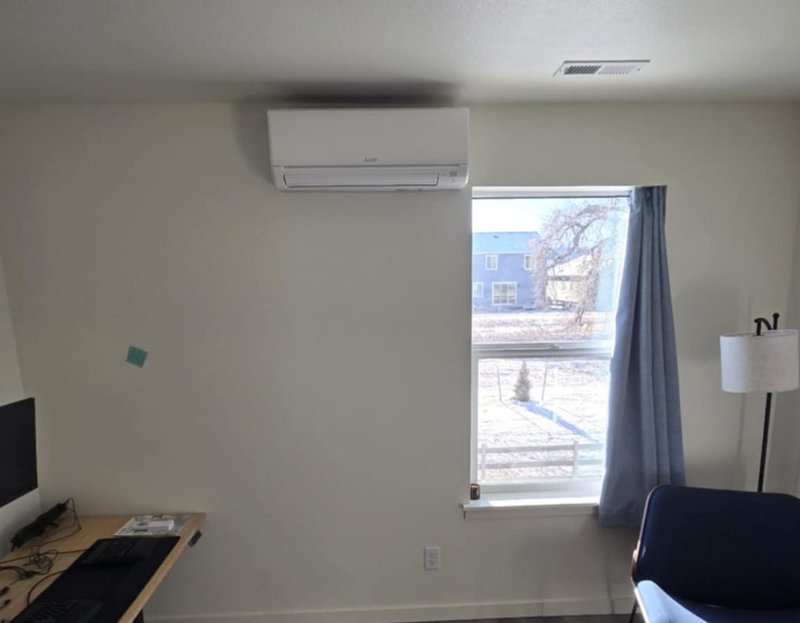
What that means for your install: These homes were not designed for central AC. Any system present today was retrofitted, usually in the 1960s or 1970s, occasionally more recently. Ductwork is often undersized. Many Campus Corner–area rentals have window ACs instead of or supplementing central systems. For owner-occupants who want a properly done install, the honest answer is often one of two paths: (1) retrofit central AC with new oversized ductwork (expensive, disruptive, but delivers modern comfort), or (2) multi-zone ductless mini-splits (cleaner, less invasive, often the better choice for a 1,400–1,800 sq ft historic home).
Rental-property reality: We get it — if you own a rental on White Street and it houses four OU students who'll sublet to four different students next year, a $12,000 mini-split system isn't the right call. For landlord rentals, we quote the most reliable, lowest-cost system that will pass Norman's housing code and not die in the middle of summer finals week. That usually means a basic 2.5–3 ton 14 SEER2 Goodman or similar with sturdy components and a straightforward maintenance path. $4,500–$5,800 range, tested and commissioned, handed off with a warranty registration for the next owner.
OU game-weekend logistics
Norman AC emergencies spike on home-game weekends. Stadium crowd means 80,000+ people, and Campus Corner restaurants are packed — if your commercial rooftop unit fails on a Friday afternoon before a Saturday game, you need a same-day fix, not a Monday appointment. We keep Saturday staffing during OU football season specifically because we know the pattern. Call early and we'll do our best.
Central Norman: postwar ranches and mid-century homes (1950s–1980s)
What we see: Between Robinson Street and Main Street, bounded roughly by Berry Road to the west and 24th Avenue to the east, central Norman has a deep inventory of postwar ranch homes, ~1,200–2,200 sq ft, single-story, with adequate ductwork for today's equipment. Many have been through one or two HVAC replacements already. These are the simplest Norman installs — honest workhorses for families who want reliable cooling without paying premium-brand tax.
What that means for your install: Expect 2.5–3 ton replacements in the $5,000–$6,500 range using mainstream equipment. Straightforward single-day install. We replace the evaporator coil, condenser, and line set; pressure-test the lines to 500 PSI; pull a deep vacuum; commission the system with manufacturer-spec charge by weight; and walk you through the new thermostat.
South Norman and east Norman: new builds (2000s–2020s)
What we see: Neighborhoods like Trail Woods, Summit Lakes, Cedar Lane, and new development along Highway 9 and 24th Avenue SE. Homes are 2,200–4,500 sq ft, 2000s–2020s construction, with modern ductwork and modern electrical panels. Equipment in these homes is usually 10–20 years old now and hitting the replacement window.
What that means for your install: Same-tonnage replacement with an efficiency upgrade (14 SEER to 16 SEER2 or higher) is the typical path. Budget $5,500–$8,500 for single-system 3–4 ton installs. Two-stage or variable-speed equipment is usually worth the premium in Oklahoma's climate — it removes more humidity and cycles less aggressively than the single-stage builder-grade units these homes originally had. Better comfort, longer equipment life.
Franklin-Denver, Adkins Crossing, and rural-adjacent Norman
What we see: Homes on 2+ acre lots around the edges of the Norman city limits, often with well water, septic, and propane heating. Larger lot sizes mean outdoor condenser placement is easy, but sometimes the electrical service doesn't have headroom for a modern condenser's startup amperage.
What that means for your install: Electrical panel assessment is part of every rural-adjacent Norman estimate we do. If your panel is original 1980s 100-amp service and you've been adding electric vehicles or a new electric water heater, you may already be at capacity. A modern condenser with a hard-start kit typically draws 40–60 amps on startup; that needs a dedicated breaker with room to trip safely. If the panel needs an upgrade before AC work, we'll tell you and refer a licensed electrician.
Norman permit process
Norman's City Hall handles mechanical permits for HVAC installations. We pull the permit directly; cost is typically $50–$85 for a residential AC replacement, included in our quote. The City of Norman inspector verifies condensate drain, disconnect, clearances, and refrigerant line insulation after install. We coordinate and attend the inspection.
For historic district homes (Chautauqua, Miller, Silk Stocking), Norman does not impose as strict an exterior-visibility review as OKC's Heritage Hills does — but we still plan condenser placement thoughtfully, because these neighborhoods are protective of streetscape character and a jarring equipment placement generates neighborhood complaints that nobody wants.
Norman pricing guide (2026)
- Basic 2.5–3 ton replacement for OU-area rental: $4,500–$5,800
- Owner-occupied central-Norman ranch, 3 ton 15 SEER2: $5,500–$7,000
- South Norman new-build, 3.5–4 ton two-stage 16 SEER2: $6,500–$8,500
- Variable-speed premium install, large new build: $8,000–$9,500
- Multi-zone ductless mini-split for Campus Corner historic home: $6,500–$11,000
- Rural-adjacent install requiring electrical panel work: add $800–$2,500 for panel upgrades (done by a licensed electrician)
Why we work well for Norman landlords
Rental-property AC work has specific requirements that don't always map to owner-occupied installs. Landlords typically want: itemized invoices for tax depreciation; warranty paperwork transferred to a neutral business contact rather than the current tenant; straightforward mid-range equipment, not premium systems; tenant-coordinated scheduling; and follow-up documentation for housing-code inspection records. We do all of this as standard practice. If you own multiple properties, we can set up a preferred-customer rate structure and prioritize your calls.
What we don't do: over-spec systems for rentals, charge emergency rates to landlords who need reactive service, or recommend premium equipment where a reliable mid-range system will do the job. A rental is not the place to sell variable-speed luxury — it's the place to install a system that will work reliably for 12–15 years with minimal tenant complaints, and we know it.
What you should expect from any Norman installer
Before you sign a quote with anyone — us or a competitor — here's what a legitimate Norman AC installer should provide: a written quote with itemized equipment and labor, a Manual J load calculation (or a documented reason why one isn't needed), permit inclusion, proof of current OK CIB HVAC license (ours verified here, not just a handyman or general contractor license), proof of liability insurance, a specific install date, and a warranty document referencing both the manufacturer's parts warranty and the installer's labor warranty. If a quote is missing any of these, it's not a complete quote — it's a number with a handshake behind it.
The OU football season service calendar
Norman is functionally two cities: one with a regular population of about 128,000, and one that swells by 85,000+ on eight Saturdays each fall when OU plays at home. That second Norman — the game-weekend Norman — creates HVAC demand patterns nothing else in the metro matches. Here's how we plan around it:
July–early August: the landlord pre-lease rush
OU fall leases typically start August 1. Landlords with rentals near Campus Corner, along Buchanan or Asp or Boyd, want units ready for tenant move-in. Any system that's been marginal through spring gets replaced or repaired in this window. Our July calendar in Norman fills up by late June most years. If you're a landlord with a rental that's been limping along, don't wait for July — call in May.
Late August–September: the tenant discovery phase
New tenants move in, run systems hard, and discover the issues landlords didn't catch. We get a meaningful spike in Norman repair calls in these six weeks — especially for older OU-area homes where the previous tenants quietly lived with a marginal system. Landlords who have a maintenance agreement with us see these issues addressed faster.
Fall game weekends (September–November): emergency-only
During home-game weekends (typically 5–7 weekends in this window), we prioritize Norman emergency calls but we don't schedule planned installs on game Saturdays. Traffic is impossible, parking at the jobsite is often impossible, and the homeowner usually has 12 people over watching the game anyway. We'll schedule around the game for planned work, and we run emergency dispatch for no-cool/no-heat situations normally.
December–May: the normal Norman calendar
Between football season and the summer landlord rush, Norman HVAC work runs on a conventional schedule. This is a great window for a planned install if you have flexibility — our availability is best, Norman traffic is manageable, and pricing is at typical spring/fall rates before summer peak surcharges hit.
One detail worth knowing: Norman itself doesn't have a mid-sized HVAC contractor equivalent to ARP's scale. The options in Norman are mostly (a) large multi-state franchises with sales staff and subcontracted techs, or (b) one- and two-person operations doing small-volume work. We sit between those two models, and a lot of Norman homeowners prefer that middle position.