Why AC installation in Oklahoma City is not one job — it's five
Oklahoma City spans more than 600 square miles and includes housing stock from 1890 through 2026. An AC installation in a 1906 Henry Overholser–era Heritage Hills mansion has almost nothing in common with an installation in a 2022 Deer Creek-adjacent spec build. The equipment might be identical; everything else — the ductwork, the electrical, the permit process, the HOA rules, the attic access, the refrigerant line routing — is entirely different.
That's why cookie-cutter installation quotes fail in OKC. A franchise pricing grid that works in a Dallas suburb breaks when applied to a Crown Heights Tudor built in 1931. We price by house, not by template, and the sections below explain how we approach each of OKC's five major housing-era categories.
Heritage Hills, Mesta Park, Crown Heights, Edgemere Park: historic preservation district homes (1905–1944)
What we see: Heritage Hills, Oklahoma City's first historic preservation district, contains homes from 1905 through the 1930s — Henry Overholser's 1903 mansion anchored development along Hudson Avenue, and the G.A. Nichols-built bungalows and foursquares followed between 1906 and 1930. Mesta Park, just west, has the same era of homes clustered near the old streetcar line at N. Shartel Avenue and NW 16th Street. Crown Heights, developed starting in 1931 on the former Oklahoma City Golf and Country Club grounds, is a generation newer — mostly Tudor Revival, French Eclectic, and Mission-Spanish homes along tree-lined streets. Edgemere Park, platted in 1926 as one of the first planned-unit developments west of the Mississippi, shares a similar vintage.
What that means for your install: These homes were built for gravity furnaces and window fans. Any central AC you see today was retrofitted — sometimes in the 1950s, sometimes in the 1980s, occasionally last decade. That retrofit determines everything. If the existing ducts are original retrofit (often in attic chases with very limited static pressure capacity), a new high-efficiency system will overpower them and short-cycle. We do a static pressure test as part of every historic-home estimate. If pressures are out of spec, we'll tell you whether to re-duct, downsize the equipment, or shift to a ductless mini-split — rather than install a system that will disappoint you.
HPZ rules: Both Heritage Hills and Mesta Park are Historic Preservation Districts with zoning (HPZ) enforcement by the Oklahoma City Historic Preservation Commission. Outdoor condenser placement, visibility from the street, and exterior vent penetrations all require review. We've worked these permits enough times to know what the commission approves on the first pass versus what triggers a revision. Typical HPZ-compliant installs add one to two weeks to the calendar but no meaningful cost, if the condenser placement is planned correctly from the start.
Real-world pricing for historic OKC homes
- 2.5 ton system in a 1,600 sq ft Mesta Park bungalow (reusing sound retrofit ducts): $5,500–$7,000
- 3 ton system in a 2,400 sq ft Heritage Hills home (with duct sealing, new condensate drain): $6,500–$8,500
- 4-zone ductless mini-split in a Crown Heights Tudor (no usable existing ducts): $9,500–$13,500
- Dual-system install in a 4,500 sq ft Nichols Hills home: $11,000–$15,000
Nichols Hills (1920s–1950s, premium segment)
What we see: Nichols Hills, developed by G.A. Nichols starting in 1928, is a separate municipality surrounded by Oklahoma City. Homes range from 2,800 square feet up to 8,000+, with substantial lot sizes and mature trees. Equipment specs skew high-end: Carrier Infinity series, Trane XV variable-speed, Lennox Signature. Many homes already have two-zone or three-zone systems installed.
What that means for your install: We approach Nichols Hills installations as equipment-match exercises. The goal is preserving zone balance, ensuring the new condenser is quieter than what it's replacing (noise complaints in Nichols Hills are a real thing — HOA and neighbor sensitivities run high), and using manufacturer-approved communication wiring so the existing thermostat, humidifier, and IAQ equipment keep working. Nichols Hills has its own mechanical permit process separate from OKC; we handle it.
Midtown, The Paseo, Asian District (1910s–1930s, mixed residential/commercial)
What we see: Homes mixed with apartment buildings and small commercial structures along Classen Boulevard, Walker Avenue, and the curved Paseo. The Paseo Arts District's commercial architecture is Spanish Mediterranean Revival from the G.A. Nichols era; surrounding residential is Prairie, Tudor Revival, Craftsman. Housing stock is smaller (1,000–2,200 sq ft) and denser.
What that means for your install: Smaller systems (2–3 ton), tighter mechanical closets, often no attic access. Many of these homes have had a mechanical closet or utility room carved out of an original pantry or mudroom, which constrains equipment dimensions. We carry equipment depth charts and measure before we quote — a homeowner who's been told "any 2.5-ton system will fit" has usually been told that by someone who didn't actually measure.
Midwest & NW OKC: suburban expansion (1950s–1980s)
What we see: The postwar expansion along Northwest Expressway, NW 122nd, NW 150th, and the broader Deer Creek/Quail Creek corridor. Homes in the 1,400–2,800 sq ft range, on half-acre to one-acre lots, with garages and carports and standard builder-era ductwork. This is the bread-and-butter AC-replacement segment of OKC — the largest by volume of installations we perform.
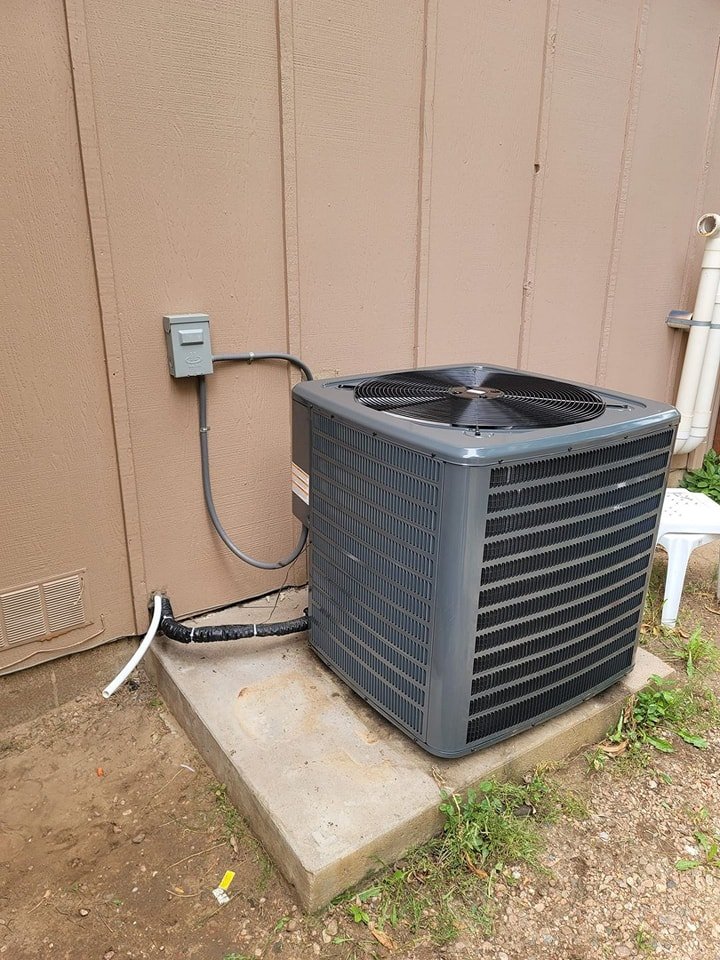
What that means for your install: Straightforward 3-ton or 3.5-ton replacements with modern 15 SEER2 two-stage equipment. Ductwork is usually adequate. Electrical panels from the 1970s sometimes need a dedicated 30-amp or 40-amp breaker added for modern condensers — that's an extra $250–$450 if your panel has space, or a call to an electrician for a panel upgrade if it doesn't. We quote the electrical honestly rather than surprising you with it mid-install.
South OKC, Capitol Hill, and Will Rogers Airport–adjacent neighborhoods
What we see: South OKC has a wider range — 1950s ranches, 1980s infill, and 2000s new builds all within a few blocks of each other. Capitol Hill (south-central OKC, south of the Oklahoma River) has a mix of commercial and residential going back to the early 1900s with significant 1990s–2000s redevelopment. Homes near Will Rogers Airport are mostly 1970s–1990s construction, often with specific noise-abatement window packages that change the cooling load slightly.
What that means for your install: Expect standard pricing for suburban-era homes. Capitol Hill historic properties require the same care as Heritage Hills. Near-airport properties benefit from modern low-noise condensers — worth the small premium for a variable-speed system if your home is close to a flight path anyway.
Far NW / Deer Creek–Piedmont corridor (2010s–2020s new builds)
What we see: New construction along NW 234th, NW 192nd, and the Memorial Road corridor into Piedmont and northern Edmond. Homes are 2,500–5,500 sq ft, 2 or 3 story, often with partial basements. Builder-installed equipment is typically 14–15 SEER single-stage, minimum spec.
What that means for your install: If you bought a new build in the last 5–10 years, your builder-spec equipment is running at the minimum legal efficiency. Upgrading to a two-stage 16 SEER2 or variable-speed 18 SEER2 system typically pays for itself in 6–9 years through lower summer bills — and runs quieter, removes more humidity, and doubles the equipment lifespan. We can usually do this as a straight swap using the existing line set if it's under 6 years old.
Oklahoma City permit process — what we handle
OKC requires a mechanical permit for any new AC installation or replacement. The City of Oklahoma City Development Services office pulls these — cost is typically $75–$120 depending on scope, included in our quote. Historic Preservation districts add a second review layer through the OKC Historic Preservation Commission, which meets monthly. For HPZ-regulated addresses, we plan the install timeline around the commission's schedule.
Post-install, an OKC inspector visits to verify refrigerant line insulation, condensate drain slope and termination, disconnect placement, and clearance from combustibles. We coordinate the inspection. You don't need to be home unless attic access is required.
Refrigerant transition (R-410A → R-454B)
The EPA's phase-down of R-410A refrigerant took effect January 2025, and all new AC systems manufactured from 2026 forward use a low-GWP refrigerant — most commonly R-454B (Puron Advance) or R-32. This has three practical implications for OKC installations: (1) existing R-410A line sets can usually be re-used after a proper flush, but older service valves may need replacement; (2) R-454B is mildly flammable (A2L classification), so indoor equipment placement must meet new ASHRAE 15 clearance standards; (3) repair costs on older R-410A systems are rising as refrigerant supplies tighten. If your existing system is pre-2020, plan for replacement within 3–5 years and budget accordingly.
Why OKC customers choose ARP over larger contractors
We're a small shop. Most OKC AC installations are done by Charlie plus one or two techs, not a crew of rotating subcontractors. That's limiting — we can't quote every job, and we turn away work during peak summer weeks. But it's also why the installs we do are right the first time: there's no handoff between the salesperson who quoted the job and the tech who's standing in your attic.
When you call (405) 413-0583 about an OKC install, you'll get a real technician on the phone, usually Charlie himself, and a real site visit before any quote is written. That's the standard we hold ourselves to, and it's why most of our OKC work comes from direct referrals by Heritage Hills, Mesta Park, Crown Heights, and Nichols Hills homeowners who've had us replace systems in their own homes.
Homes we've said no to — and why
The flip side of doing historic-home HVAC seriously is that sometimes the honest answer is "we shouldn't do this job." Three situations where we've recommended OKC homeowners hire someone else instead of us:
1. The asbestos-laden original duct system. Heritage Hills and Mesta Park homes built before 1980 occasionally have original duct insulation containing asbestos. Under Oklahoma DEQ rules, we're not the ones who handle abatement — that's a licensed asbestos remediation contractor. When we find it on a walkthrough, we recommend testing first, abatement second, and only then do we come back to do the HVAC work. That adds weeks and several thousand dollars to a project, and some homeowners reasonably decide to phase it or get a second opinion. We're fine with that.
2. The "just add a window unit" request in a Nichols Hills estate. We've had multiple Nichols Hills calls where the homeowner wants a cheap point-of-use cooling fix for a specific room rather than addressing a whole-house system issue. Usually this is the right call for them and the wrong job for us — we're not in the window-unit-installer business. We'll refer to a handyman or electrical contractor who can do that kind of work at a price that makes sense.
3. The emergency buyer's-inspection install. Occasionally a real-estate agent calls needing an AC system installed over a weekend before a closing deadline. We understand the pressure but we don't cut corners for a timeline we didn't set. If the job genuinely can't wait for a proper Manual J load calculation, permit pull, and inspection, we decline. Most of the time the buyer is better off with a seller-funded credit than a rushed install that causes a callback a year later.
The point: if you call and get a "no" from us, it's not a loss — it's an honest data point. Other contractors will say yes to all three of those situations, and some of those jobs go fine. But you asked us specifically, and we'd rather lose a quote than deliver a job we're not confident in.