The Moore HVAC market is unlike any other OKC suburb
On May 20, 2013, an EF-5 tornado traveled a 13.85-mile path through Moore, destroying approximately 1,150 homes. The rebuild that followed, largely complete by 2016, created what's essentially a coordinated housing cohort: thousands of homes within a few-mile corridor, built within a three-year window, using similar contractors, similar HVAC sub-contracts, and similar builder-grade equipment. That cohort is now 10–13 years old — and all of those systems are approaching first-major-failure age at roughly the same time.
That makes Moore statistically unusual. In most OKC suburbs, HVAC replacement demand is scattered across decades of construction; in rebuild-path Moore, demand is concentrated. Which means we see the same failures repeatedly — the same manufacturer, the same component, the same approximate age. This is useful to you as a homeowner: when we quote your Moore install, we're not guessing. We know what the original builder installed, we know how it's aging, and we know what makes sense as a replacement.
The rebuild-era failure pattern (2013–2016 installs)
Here's what we see on post-2013 rebuild Moore homes as they hit years 10–12:
Year 6–8: capacitor failures
The dual run capacitors originally installed in 2013–2015 builder-grade condensers were usually 35+5 μF or similar. Oklahoma heat is hard on them. Most fail between years 6 and 8. This is a $175–$350 repair, not a replacement trigger — but it's the first warning signal.
Year 9–11: blower motor and condenser fan motor failures
ECM blower motors from the rebuild era have a known failure pattern when run aggressively (which Oklahoma summers demand). Most rebuild-home blower motors start to exhibit ramp-up issues, noise, or full failure around year 9. That's a $650–$1,200 repair. At this age, we have the first real "repair or replace" conversation with homeowners.
Year 11–14: refrigerant leaks and compressor issues
Thin evaporator coil tubing in builder-grade 2013-era equipment was a known issue. Formicary corrosion — microscopic ant-like tunnels through the copper caused by acidic airborne compounds — shows up around year 10–12. Once a coil starts leaking, the repair cost plus refrigerant recovery plus R-410A scarcity (the refrigerant is phasing out in 2025–2026) plus labor often exceeds $2,500–$3,500. At that point, replacement is almost always the better call.
What this means for you
If your Moore home was built or rebuilt between 2013 and 2016 and your original HVAC equipment is still in place, you're approaching the replacement window. You don't have to replace today — if the system is running fine, enjoy it. But plan for replacement in the next 1–4 years, budget $5,000–$7,500, and don't be surprised when the first major failure arrives.
Moore's stronger building code — and why it matters for HVAC
After the 2013 tornado, the City of Moore adopted building code revisions stricter than the Oklahoma statewide baseline: continuous sheathing on exterior walls, ring-shank nails instead of smooth, hurricane-rated roof ties, and specific anchor-bolt spacing. These codes apply to new construction and significant rebuilds. They don't directly regulate HVAC equipment, but they change the context for HVAC work.
Specifically: a post-2013 Moore home has a tighter building envelope than a similar-vintage home in most other OKC suburbs. That affects load calculations. A 2,200 sq ft home rebuilt in 2014 may only need a 2.5-ton AC, where the same 2,200 sq ft home built in 2005 Moore would have needed 3 tons. Getting this right is why Manual J load calculations matter — they're not a formality, they're the difference between a system that runs properly and one that short-cycles.
Neighborhood patterns in Moore
The rebuild corridor (Plaza Towers, Briarwood, Westmoor areas)
The 2013 tornado path ran roughly from SW 149th Street across to Telephone Road, through the neighborhoods west and east of the Moore Medical Center on I-35. Homes rebuilt in this corridor are post-2013, built to the stricter Moore code, with modern building envelope performance. HVAC needs: slightly undersized compared to pre-tornado homes, usually 2.5–3 ton. Budget $4,800–$6,500 for a standard 3-ton 15 SEER2 replacement.
Eastlake Estates & east-of-I-35 newer construction
East of I-35, newer Moore neighborhoods have slightly larger homes (2,400–3,800 sq ft) with modern ductwork and adequate electrical panels. Replacement needs are mainstream. Budget $5,500–$8,500 for 3–4 ton two-stage installs.
Pre-tornado Moore (Old Town, Broadmoore, older Southgate)
Homes that weren't in the 2013 path are mostly 1970s–1990s ranches with the usual Oklahoma suburban HVAC profile. Nothing unusual — mainstream 2.5–3 ton replacements in the $4,500–$6,500 range, standard ductwork, standard timeline.
149th-I-35 corridor / far south Moore
Newer development along SW 149th and south into the Norman–Moore boundary area. Larger lots, newer homes (2010s–2020s), sometimes on well/septic, sometimes with electric-only heating that makes heat pump installation a natural fit.
What we install in rebuild-era Moore homes
For a typical 2,200 sq ft Moore rebuild home with original 2014-era equipment failing, we almost always recommend a 2.5–3 ton 15 or 16 SEER2 two-stage system. The two-stage matters: it lets the compressor run at lower output most of the day, which removes more humidity and keeps temperature swings smaller. In Oklahoma's muggy summers, a two-stage system feels dramatically more comfortable than the single-stage builder unit you're replacing, even if the "how cold it gets" number is identical.
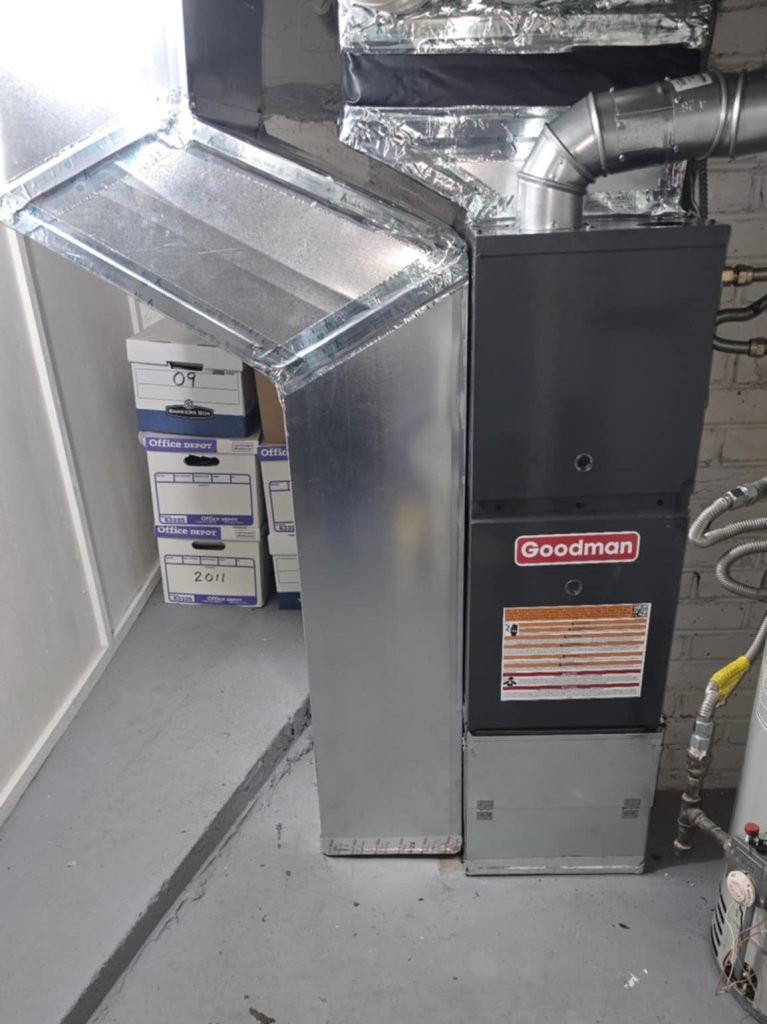
We're brand-agnostic. For budget-sensitive installs we recommend Goodman. For mid-range we recommend Rheem or Carrier. For premium we recommend Trane XV or Carrier Infinity. The difference between Goodman and Trane at the installation stage is roughly $1,500–$2,500; over 15 years of operation the long-term cost is often closer to a wash if the install was done right.
Condenser placement in Moore (tornado considerations)
Let's be honest: no outdoor condenser will survive a direct EF-3 or stronger tornado strike. No amount of anchor bolting or pad reinforcement changes that. What good placement does is improve the odds in EF-0 to EF-2 events (which are vastly more common than EF-4+ events) and minimize damage from hail and straight-line winds.
Our Moore condenser placement practices: concrete pads anchored with 3/8" threaded rod into the pad, not the lightweight "tie-down strap" that comes in the installation kit; condenser placed on the downwind side of the house from prevailing summer storm tracks (usually north or east side in central Oklahoma); refrigerant lines routed through a protected wall penetration rather than a long exposed exterior run; service disconnect sized so you can shut off the unit quickly if you need to during severe weather. None of this is tornado-proof. It's just professional installation that respects Moore's environment.
Moore permit process
The City of Moore requires mechanical permits for HVAC installations. Permit cost is typically $60–$90, included in our quote. The city inspector verifies compliance with Moore's post-2013 building code — including condenser pad installation and disconnect placement. We pull the permit, schedule the inspection, and attend it.
Pricing guide for Moore (2026)
- Post-2013 rebuild home, 2.5–3 ton 15 SEER2 two-stage: $4,800–$6,500
- Standard 1990s–2000s Moore ranch, 3 ton replacement: $5,000–$6,500
- Larger newer home (2,800+ sq ft), 3.5–4 ton: $6,500–$8,500
- Premium variable-speed, large home: $7,500–$9,500
- Dual-fuel heat pump + gas furnace setup: $7,000–$10,000
Why we're a reasonable choice for Moore
We're based in Edmond, about 25–35 minutes north of Moore via I-35. We're not a Moore company, and we don't pretend to be. But we've replaced a significant number of Moore systems over the years, we know the rebuild-era failure patterns, and we know what the building code requires. When a Moore homeowner calls us, we aren't running a local radio ad or buying Moore Google Ads — we're getting referred by another Moore homeowner who was happy with our work. That's the whole business model, and it works for us.
Moore rebuild-era HVAC timeline (2013–2026)
If you own a Moore home built or rebuilt between 2013 and 2016, your HVAC equipment is following a predictable aging curve. Here's what we actually see in the field, year by year:
Years 0–5 (2013–2018): honeymoon period
Equipment runs without major issues. Annual maintenance catches minor things — thermostat recalibration, condenser coil cleaning, filter changes. Total annual maintenance cost: $150–$300.
Years 5–7 (2018–2020): first wave of minor failures
Capacitors, contactors, and thermostat upgrades. Most Moore homeowners from this cohort paid $175–$400 per call. Nothing dramatic. Equipment still performs to spec.
Years 7–9 (2020–2022): blower-side issues begin
ECM blower motor ramp-up noise, occasional condenser fan motor failures. Repairs in the $450–$1,100 range. Homeowners start asking "how much life is left?" for the first time.
Years 9–11 (2022–2024): the coil-leak inflection point
Evaporator coil formicary corrosion surfaces as refrigerant loss. First-time service visits discover slow leaks; patches are temporary at this age. This is the year many Moore homeowners decide to start planning a replacement.
Years 11–13 (2024–2026): replacement window opens
This is where the 2013–2016 cohort is now. Repair-or-replace conversations become serious. We've quoted hundreds of Moore rebuild-era replacements in the last 18 months. The consensus budget is $5,000–$7,500 for a 2.5–3 ton 15–16 SEER2 two-stage upgrade.
Years 13+ (2026 onward): compressor and refrigerant-transition pressure
Once a system crosses the 12-year mark AND is still on R-410A refrigerant, the repair math changes permanently. R-410A cost has risen roughly 40% since 2023 as the phase-down accelerates. A 2014-era compressor replacement with R-410A top-off in 2026 can land in the $3,500–$4,800 range — and the system is still 13 years old on the back end. Almost always, replacement is the better call by this point.
We track this cohort closely because we'll be working on these homes for the next 15–20 years. If you're in the rebuild corridor and want an honest read on where your specific system is in this curve, call and we'll do a free assessment.