Yukon is a town of two HVAC eras
Yukon was founded in 1891 as a Choctaw, Oklahoma and Gulf Railway stop, grew as a Czech immigrant farming community through the early 1900s, became a Route 66 highway town when U.S. 66 was aligned through Main Street in 1926, and in the 21st century has boomed southward into new-build suburban neighborhoods along and past I-40. That history shows up directly in the housing stock — and in how we approach an AC installation.
From our perspective, Yukon splits into two categories: older homes on and near Main Street (Route 66), and newer homes south of I-40 and along Garth Brooks Boulevard. Each needs a different conversation.
Historic Main Street / Route 66 corridor
What we see: North of I-40, along Main Street where the restored Yukon's Best Flour Mill neon sign still lights up at night, the homes are mostly 1920s–1950s, with some earlier 1890s–1910s Victorian-era stock tucked on side streets. Two miles south of town, the Czech Hall (Jan Zizka Lodge #67, NRHP-listed since 1980, originally built in 1901) has hosted Friday polka dances for generations and remains the anchor of Yukon's Czech heritage. Many of these homes are single-story frame construction, 900–1,800 square feet, with retrofit central AC installed in the 1970s or 1980s.
What that means for your install: Like OKC's Heritage Hills or Norman's Campus Corner historic area, these homes weren't designed for central AC — what's present is a retrofit. The original ductwork is often undersized by modern standards, and the attic space may be limited. The right answer for a Main Street Yukon home depends on what's already there:
- If existing ducts are sound and passed a static pressure test: a modest 2–2.5 ton 14 SEER2 system is usually fine. Budget $4,500–$6,000.
- If existing ducts are restrictive or damaged: we recommend either re-ducting (significant disruption, but delivers modern comfort — budget add $2,500–$5,000) or a ductless multi-zone mini-split (cleaner, minimal structural impact — $6,000–$10,000 for the whole installation).
Yukon's historic resources
When we work on homes along Main Street, we try to be respectful of Yukon's character. The Main Street historic commercial district, the Chisholm Trail crossing marker at S Holly Avenue, the Yukon Historical Museum in the original 1910 high school building at 601 Oak Street, and the cultural importance of the Czech Hall and the Mulvey Mercantile — these matter to Yukon residents, and we try not to leave visible scars on older homes just to install equipment faster.
South of I-40: the new-build boom
What we see: South of Interstate 40, along Garth Brooks Boulevard (renamed in the 1990s for Yukon's most famous native), and into newer developments like Castlewood Trails, Yukon Hills, and the coming Magnolia Harbor community near Route 66 Park, Yukon has grown significantly. Homes are mostly 2000s–2020s, 1,200–2,800 sq ft, with modern ductwork, modern electrical, and modern everything. These are straightforward, mainstream AC installations.
What that means for your install: Most Castlewood Trails and similar new-build homes have builder-installed 13–14 SEER single-stage equipment that's hitting year 10–15 now. Same-tonnage replacement with a modern two-stage 15–16 SEER2 system is the typical upgrade path. Budget $5,500–$7,500 for a 3-ton install; $6,500–$8,500 for a 3.5–4 ton variable-speed system on a larger home.
Rural Canadian County context
Yukon sits in eastern Canadian County, with more rural housing stretching west toward El Reno and Calumet. Some homes technically addressed as "Yukon" are actually on 1+ acre lots outside the city limits, with well water, septic, and sometimes propane heating instead of natural gas. For these homes, we think carefully about heat pump versus AC-plus-furnace setups — electric-only heating is sometimes the simpler answer and may qualify for federal energy-efficiency tax credits depending on your specific situation.
Wind and hail considerations
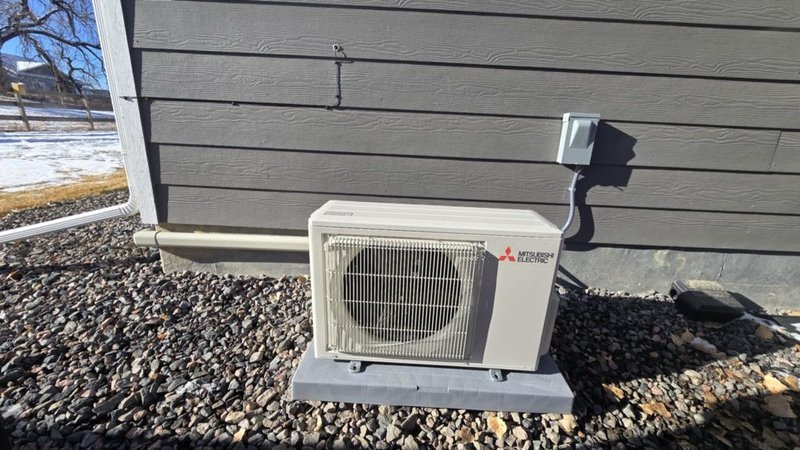
Canadian County is open prairie. High winds are a regular feature — spring, summer, and fall. We anchor Yukon condenser pads more aggressively than we do in sheltered Edmond neighborhoods: 1/2" threaded rod through the pad into the underlying slab, epoxied in place, not the flimsy tie-down strap that comes in the manufacturer kit. For homes with significant hail exposure (which in Oklahoma means effectively all of them), we recommend aluminum hail guards on the condenser coil. These add about $85–$125 to an install and can save a compressor replacement after a single severe storm. Given how cheap the upgrade is and how common Oklahoma hail events are, this is an easy call.
Yukon permit process
The City of Yukon requires mechanical permits for HVAC work. Typical cost is $50–$75, included in our quote. The Yukon city inspector verifies disconnect placement, condensate drain design, refrigerant line protection, and proper clearance from gas meters or electrical panels. We pull the permit and schedule the inspection.
For homes outside Yukon city limits (Canadian County unincorporated), Canadian County permitting applies — slightly different process, same overall scope. We handle either without issue.
Yukon pricing guide (2026)
- Main Street / Route 66 historic home, 2.5 ton retrofit: $4,500–$6,000
- Castlewood Trails or similar new-build, 3 ton 15 SEER2 two-stage: $5,500–$7,500
- Larger Yukon Hills or south-Yukon new build, 4 ton variable-speed: $7,500–$9,500
- Multi-zone mini-split for Main Street historic home: $6,000–$10,000
- Rural Canadian County install with panel upgrade: add $800–$2,500 for electrical
- Hail guards (recommended): $85–$125
Why Yukon homeowners call us instead of local Canadian County shops
There are good HVAC companies in Canadian County. We're not the only option, and we don't claim to be. What we offer that's sometimes harder to find locally: a written Manual J load calculation on every quote, a real OK CIB contractor license (verify it yourself at cib.ok.gov), a single-day install on most replacements, a 30-minute drive from our Edmond HQ (we're not the closest, but we're close enough to respond when something goes wrong), and a business model built on referrals rather than aggressive sales — which means we'd rather turn down work we can't do properly than take on a job we'll do badly.
A lot of our Yukon customers found us because we did work for their neighbor, or their in-law, or the guy who owns the diner they go to on Saturday mornings. That's how it should work in a small community, and it's how we like to earn business.
What makes a Yukon AC install actually go well
The three things that separate a successful Yukon install from a mediocre one: (1) a proper load calculation, so we don't oversize the equipment and create humidity problems or undersize it and run it to death, (2) correct refrigerant charge verified by weight and by sub-cooling/superheat check, not just "gauge it 'til it feels right," and (3) proper commissioning — meaning we let the system run long enough to verify it's actually performing to spec before we leave. This takes 3–4 hours at the end of an install day, and some contractors skip it to move on to the next job. We don't.
A properly installed 14 SEER2 system will outperform a sloppily installed 20 SEER2 system every time. Quality of install matters far more than SEER rating on the sticker. If you remember only one thing from this page, make it that.
The I-40 divide: why Yukon is really two HVAC markets
Drive north-south across Yukon on Garth Brooks Boulevard and you'll cross Interstate 40. That single highway split is the most important demographic and HVAC dividing line in the city — bigger than ZIP codes, bigger than school districts, bigger than income. It splits Yukon's housing stock into two populations that need essentially different approaches from us.
North of I-40: the historic corridor
Main Street, the downtown grid, the Route 66 alignment, and the residential streets on either side of Czech Hall Road. Housing here is 1920s–1960s primarily, with some 1890s–1910s stock. Lot sizes are smaller, homes are smaller, systems are smaller (2–3 tons is typical). Ductwork is almost always retrofit rather than original, which means static pressure is often the constraint, not the equipment. Homes here were not designed for central AC; any system that exists is a compromise, and our job is to minimize the compromise.
What we quote north of I-40 looks different: smaller systems, more careful duct diagnostics, more frequent ductless mini-split recommendations, and occasionally a "your existing system is fine, don't replace yet" answer on the walkthrough. Budgets here are typically $4,500–$6,500 for standard work.
South of I-40: the new-build corridor
Castlewood Trails, Yukon Hills, Magnolia Harbor, the developments along Garth Brooks Boulevard south toward SW 15th. Housing here is 2000s–2020s construction, larger footprint (1,800–3,200 sq ft typical, some much larger), modern ductwork sized for modern equipment, and electrical panels with plenty of capacity. Current equipment is usually builder-grade 13–14 SEER nearing the end of its service life.
What we quote south of I-40 looks different: 3–4 ton systems, straightforward replacements, room for SEER2 upgrades without ductwork surgery, and usually a same-tonnage swap that delivers meaningfully better comfort thanks to two-stage or variable-speed compressors. Budgets here are typically $5,500–$8,500.
Why this matters for your quote
If you call for a Yukon quote, the first question after your address is probably "is that north or south of I-40?" because the answer sets our framework for everything that follows — tonnage, equipment tier, ductwork plan, budget range, expected install timeline. We don't apply a one-size-fits-all template; Yukon's geography doesn't allow for one.